
 In parallel, I was working with another concept: rural education, specifically through the One Laptop per Child project. We built systems to provide digital learning resources to school children in remote areas, utilizing solar and battery-powered offline servers and local Wi-Fi networks to bypass the lack of reliable Internet.
Over time, the ideas rubbed off from one project to the other. Eventually, I found an opportunity to transfer this technical knowledge to the global health sector through volunteer work with WiRED.. My time with WiRED taught me that delivery technology is fundamentally agnostic, regardless of the content. The same hardware and network infrastructure used to deliver a second-grade math textbook can be directly pivoted to provide clinicians and community health workers with critical training on sanitation and infectious diseases.
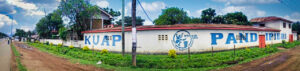 In another instance, I worked on a WiRED project in Kenya, where we built power-resilient databases running on a Raspberry Pi (a tiny computer) so that in case of power brownouts the database would remain intact and would survive multiple power cycles. The effort involved the development of a database constructed around the current patient intake forms, clinician reports and other paperwork that tracked a patient through each station at the clinic. In addition to gathering the information for use in treating patients, the database compiled monthly reports required by local and national health officials. We worked with a team in Kenya. The two groups — in the U.S. and in Kenya — worked collaboratively over 10,000 miles apart, using email and Dropbox to coordinate our work. Eventually, with phone calls through the night and into the early morning hours, we got the system set up . . . and it worked!
With this in mind, I accepted the challenge to create the technology that allows WiRED to offer health information modules to people in regions completely disconnected from the Internet. I built the infrastructure to create a mobile clinic that fit entirely into a single field-ready suitcase. It contained two laptops for clinicians, a server capable of holding medical records and its own local Wi-Fi network, all running seamlessly on battery power.
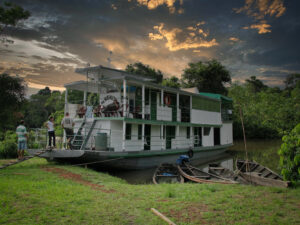
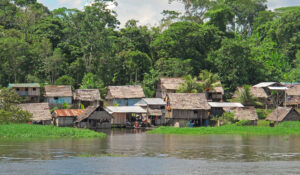 Seasoned boatmen carried this suitcase up the Amazonas River in Peru to isolated settlements accessible only by water. The laptops set up in temporary village clinics used portable Wi-Fi to connect to a server on the boat, where patient data were stored and made available for collaboration among the medical team. With this instant infrastructure, doctors set up camp, examined local residents, generated prescriptions and provided essential medical services where care had previously been unavailable.
Seeing the solutions I had spent years developing for education successfully adapted to support healthcare workers in the Amazon was a deeply fulfilling experience. Even more remarkable was that everything operated seamlessly beyond the reach of traditional power, phone and internet grids, helping address the health needs of people living deep in the jungles of South America. Making this possible required a dedicated team: my IT solutions, WiRED’s advance team, a rugged boat crew and volunteer doctors who delivered healthcare services under some of the most austere conditions imaginable.
 Organizations like WiRED demonstrate the incredible power of collaboration and the necessity of partnership. A lot of the work we do in the technology sector is designed to solve “first world” problems, built on the assumption that we have access to plenty of resources. However, the most impactful innovations often come from rotating our approach: taking designs intended for resource-rich environments and adapting them with creative modifications, such as low-power machines, to serve low-resource areas.
We are simply pivoting solutions to empower these communities, providing them with the resources they need to become an active part of the problem-solving team. When we creatively reapply what we already know to help others, we prove that collaboration is not a lost concept, and that we can work together to build a healthier, more capable world. For that, I am grateful to Gary and WiRED for letting me be a part of that journey. Let’s lift all boats.
